🔍 SEO in the AI Era: How to Optimize Content for Google, AI Answers, and Answer Engines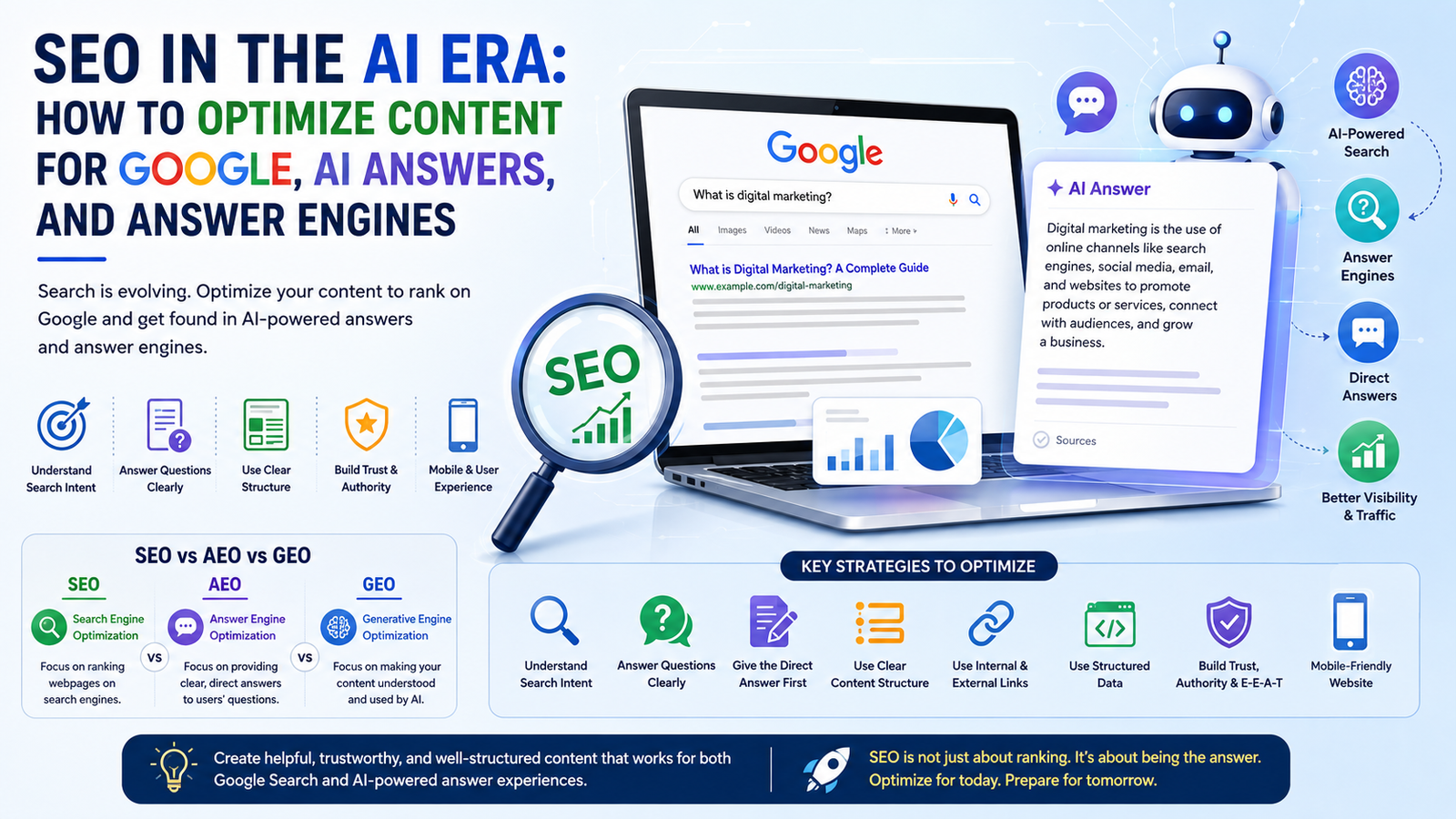
Introduction
SEO is one of the most important parts of digital marketing. SEO stands for Search Engine Optimization, which means optimizing a website and its content so that it can appear higher in search engine results and attract organic traffic.
Traditionally, when people wanted an answer, they searched on Google, saw a list of websites, and clicked on the result that looked most useful.
But search is changing. 🤖
Today, people are also using AI-powered search and answer engines to get direct answers to their questions. Instead of only showing a list of links, AI systems can understand a question, combine information, and provide a summarized answer.
Because of this change, SEO is no longer only about ranking a webpage on Google’s traditional search results. Businesses and content creators also need to think about how their content can be understood, trusted, and potentially surfaced by AI-powered answer experiences.
This is where concepts such as Answer Engine Optimization (AEO) and Generative Engine Optimization (GEO) are becoming important.
In this blog, we will understand how traditional SEO works and how businesses can create content that is useful for Google Search as well as AI-generated answers and answer engines.
📝 Summary
Traditional SEO focuses on helping search engines understand and rank webpages.
AEO focuses on creating content that clearly answers users’ questions and can be useful for answer-focused search experiences.
GEO is a newer concept that focuses on improving the chances of content or brand information being represented in generative AI responses.
The important thing is that these strategies are not completely separate.
A strong SEO strategy still provides the foundation. On top of that, businesses can create clear, helpful, well-structured, trustworthy, and easy-to-understand content that works well across modern search experiences. 🎯
Now, let’s understand how SEO is changing in the AI era.
🔍 What Is SEO?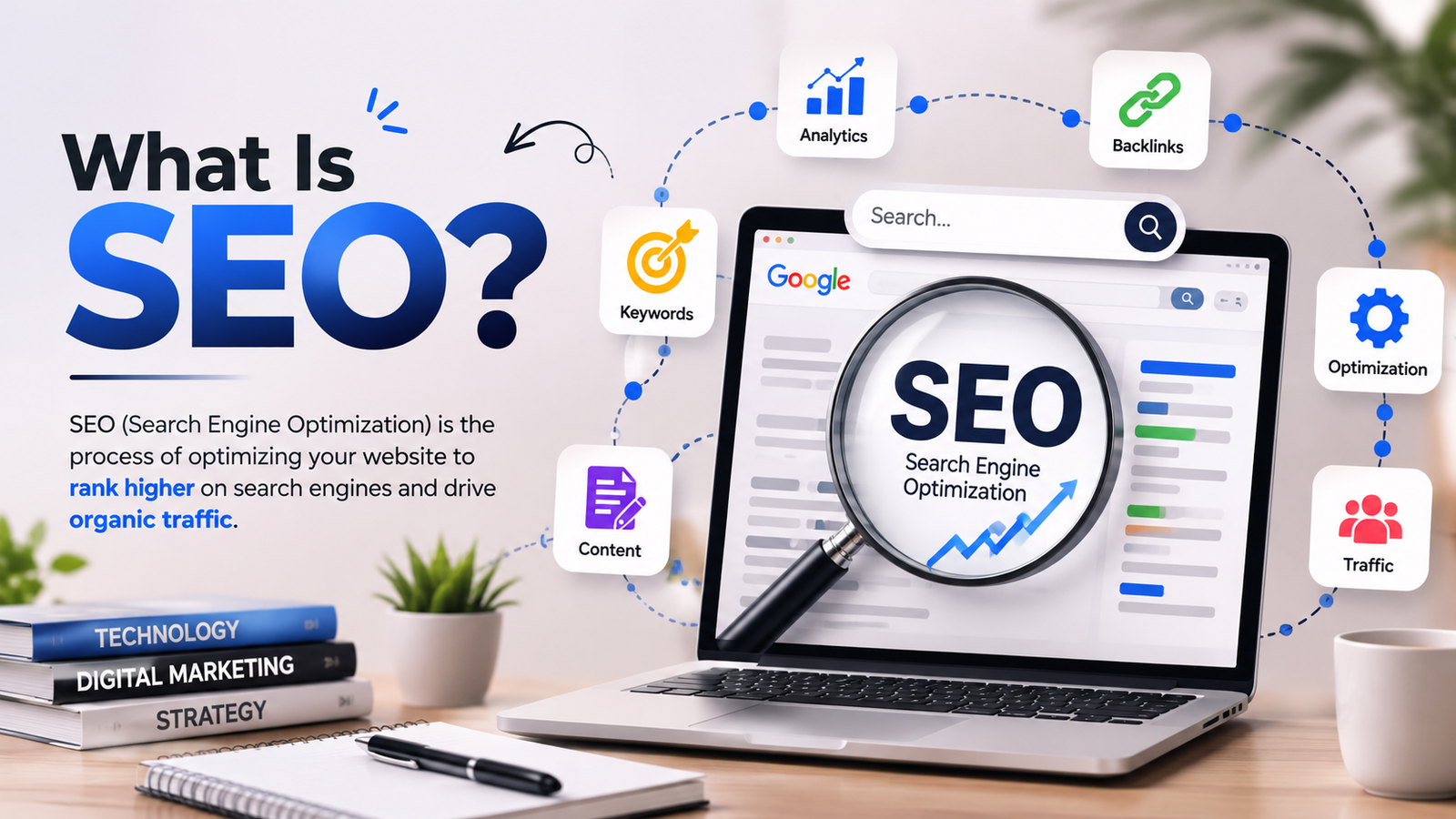
SEO stands for Search Engine Optimization.
In simple words, SEO is the process of optimizing a website so that search engines can understand its content and show it to people who are searching for relevant information.
For example, if someone searches:
“What is digital marketing?”
Google tries to understand the search query and find webpages that provide useful and relevant information.
SEO can include different activities such as:
🔎 Keyword research
✍️ Content optimization
🖥️ Website optimization
🔗 Internal linking
🌐 Link building
📱 Mobile optimization
⚡ Improving page experience
🧑💻 Technical SEO
SEO is generally divided into three major parts:
1. On-Page SEO
On-page SEO focuses on optimizing the content and elements available on a webpage.
For example:
Page title
Headings
Keywords
Content
Images
Internal links
Meta description
2. Off-Page SEO
Off-page SEO focuses on activities outside your website that can help build authority and visibility.
Examples include:
Backlinks
Brand mentions
Digital PR
Online reputation
3. Technical SEO
Technical SEO focuses on the technical foundation of a website.
Examples include:
Website speed
Crawlability
Indexing
Mobile-friendliness
Site structure
Structured data
But today, SEO is evolving because the way people search for information is changing.
🤖 How AI Is Changing Search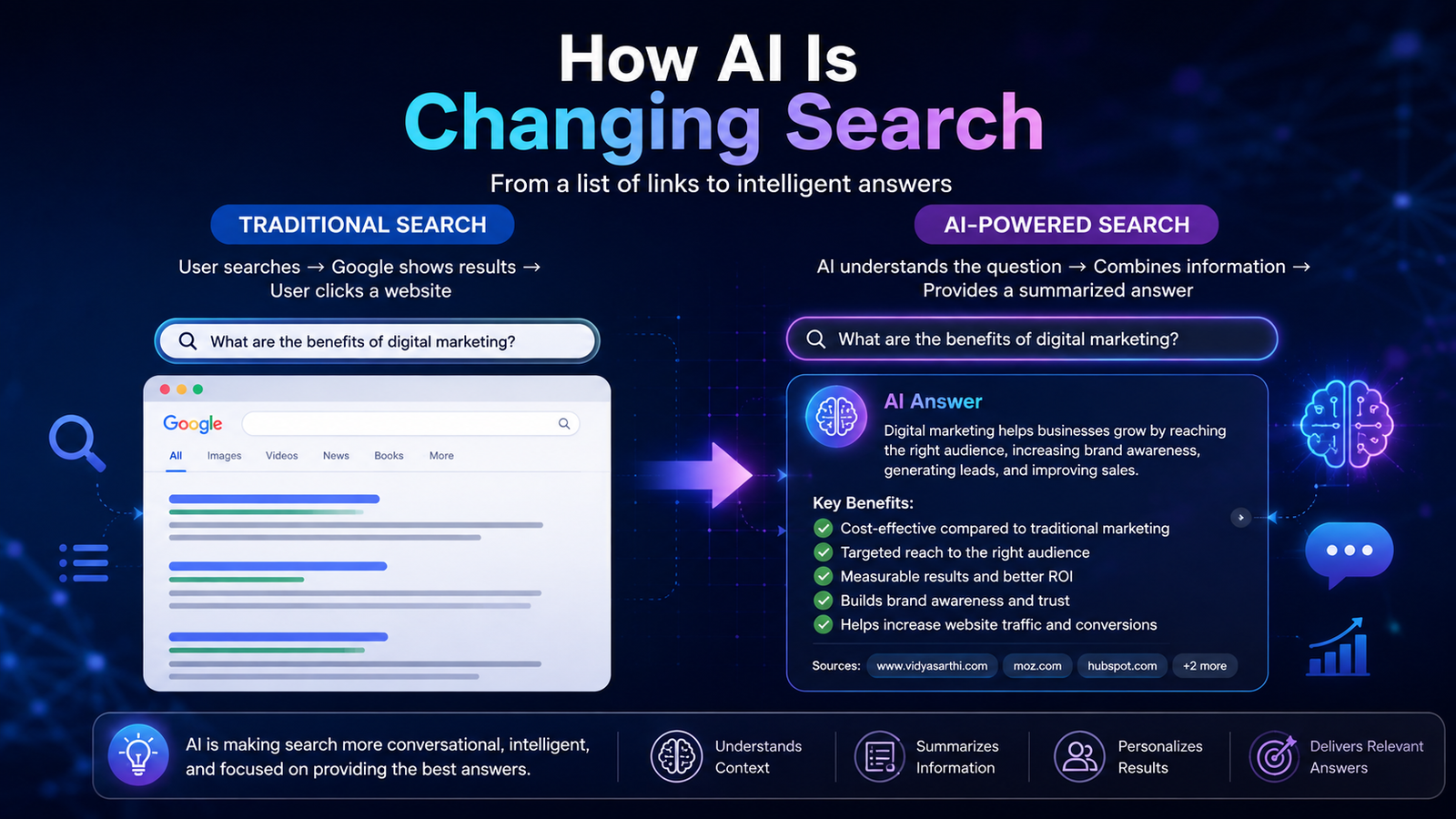
Earlier, search engines mainly provided a list of webpages.
For example:
User searches → Google understands the query → Google shows search results → User clicks a website
AI-powered search can make this process more conversational.
For example, a user may ask:
“What digital marketing skills should I learn as a beginner and in what order?”
Instead of only looking for a page matching those keywords, an AI-powered search experience can understand the complete question and provide a summarized response.
This means content needs to be created not just for keywords but also for questions, search intent, context, and usefulness.
This is one of the biggest changes happening in modern search.
💡 What Is AEO?
AEO stands for Answer Engine Optimization.
AEO focuses on optimizing content so that it can provide clear answers to users’ questions in answer-focused search experiences.
Traditional SEO often asks:
“How can I rank this webpage for a keyword?”
AEO adds another question:
“How can I provide the clearest and most useful answer to what the user is asking?”
For example, if the topic is:
“What is email marketing?”
Instead of starting with a long introduction, you can provide a simple definition near the beginning:
Email marketing is a digital marketing strategy that uses email to communicate with customers and promote products, services, or content.
Then you can explain the topic in detail.
This structure makes the answer easy to understand for both users and search systems.
🧠 What Is GEO?
GEO stands for Generative Engine Optimization.
It is a newer SEO concept focused on improving how information about a website, business, brand, or topic may be represented in generative AI search experiences.
Traditional search usually gives users links.
Generative AI can provide a generated response.
Therefore, businesses need to think about how their information is presented across the web.
For example, if a digital marketing institute wants AI systems to understand its expertise, its website should clearly communicate:
What the institute does
Which courses it offers
Who the courses are for
What topics are covered
Where the institute operates
What makes the institute different
Clear and consistent information makes it easier for systems to understand the business.
However, there is no guaranteed method to make an AI system mention a particular website or brand.
The focus should remain on creating useful, trustworthy, and well-structured information.
🔎 SEO vs AEO vs GEO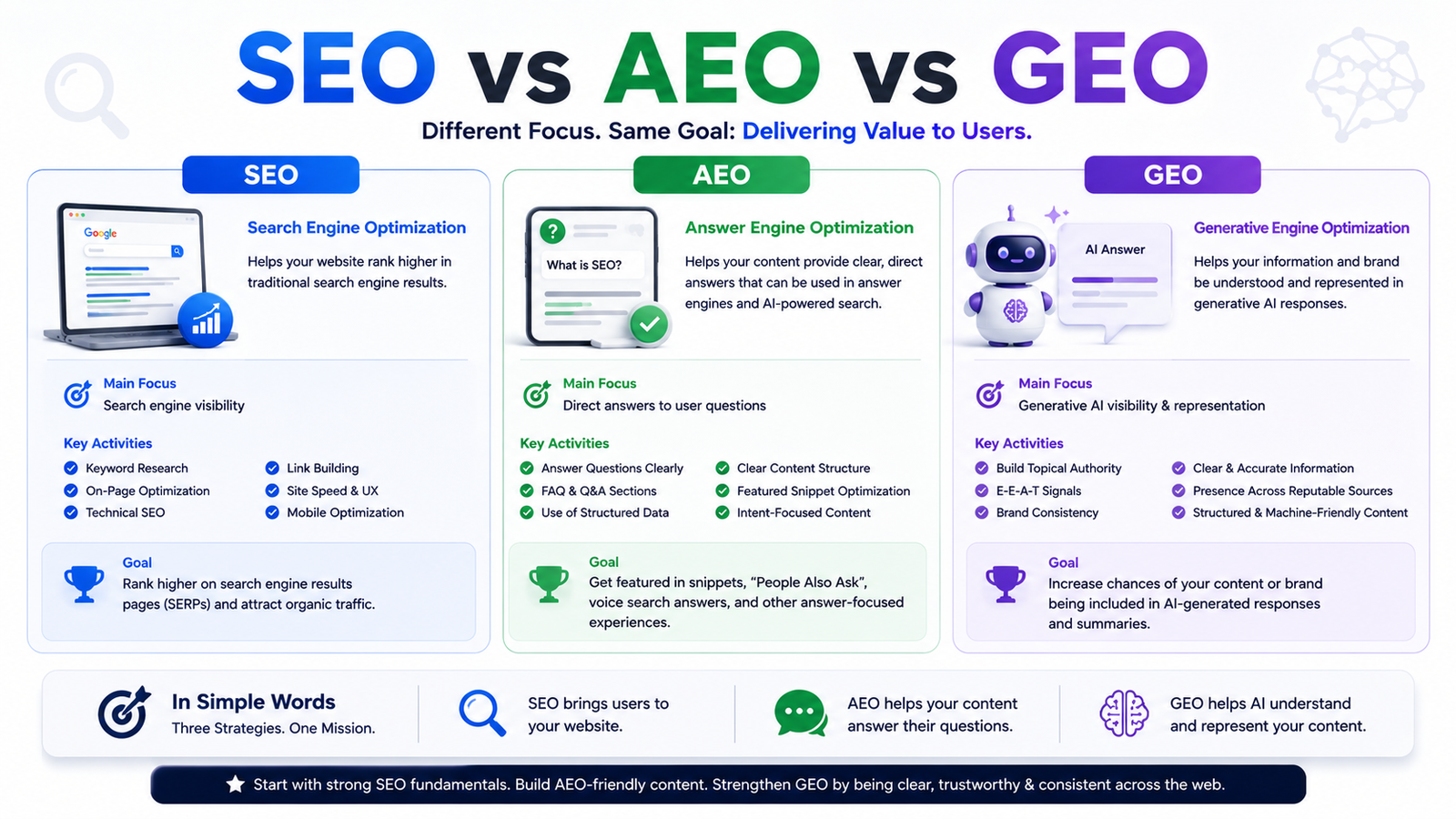
SEO, AEO, and GEO are related but have slightly different focuses.
🔍 SEO
Main focus: Search engine visibility
The goal is to help webpages appear prominently in traditional search results.
💬 AEO
Main focus: Direct answers
The goal is to structure content so that it clearly answers users’ questions.
🤖 GEO
Main focus: Generative AI visibility
The goal is to make information clear, useful, and understandable for generative AI search experiences.
These strategies should not be treated as completely separate.
A strong SEO strategy can provide the foundation for AEO and GEO.
🎯 How to Optimize Content for Google and AI Answers
Now the main question is:
How can you optimize your content for traditional Google Search as well as AI-generated answers?
Here are some practical methods.
1. 🔎 Understand Search Intent
Before creating content, understand what the user actually wants.
For example, the search:
“What is SEO?”
has an informational intent.
The user wants to learn something.
But:
“Best digital marketing course near me”
has a different intent because the user may be looking for a course.
Understanding search intent helps you create content that actually solves the user’s problem.
2. ❓ Answer Questions Clearly
AI-powered search experiences are designed to understand questions and provide answers.
Therefore, include important questions related to your topic.
For example, an SEO article can include:
What is SEO?
Why is SEO important?
How does SEO work?
What are the types of SEO?
How is AI changing SEO?
What is AEO?
These headings make your content easier to scan and understand. 📌
3. ✍️ Give the Direct Answer First
One useful approach is to answer the question clearly before providing a detailed explanation.
For example:
What Is AEO?
AEO stands for Answer Engine Optimization. It is the process of creating and structuring content so that it clearly answers users’ questions in answer-focused search experiences.
After the direct answer, you can explain the topic in more detail.
This approach helps users find the information quickly while still giving them deeper information when they continue reading.
🧱 4. Use Clear Content Structure
Good structure is important for both users and search systems.
Use:
H1 for the main topic
H2 for major sections
H3 for subtopics
Short paragraphs
Bullet points
Numbered lists
Tables where useful
Relevant internal links
Avoid creating one huge block of text.
For example:
What Is SEO?
Types of SEO
How SEO Works
SEO in the AI Era
SEO vs AEO vs GEO
This makes the article easier to understand and navigate.
🧑💻 5. Focus on Helpful and Original Content
AI can generate content quickly, but simply producing large amounts of AI-generated text does not automatically make content valuable.
Your content should provide something useful.
You can add:
Original examples
Expert explanations
Real experiences
Data and research
Case studies
Step-by-step processes
Practical tips
For example, instead of simply saying:
“SEO is important for businesses.”
Explain why it is important and give a practical example.
This makes the content more useful for the reader.
🏆 6. Build Trust and Authority
Trust is important in search.
Businesses should clearly communicate who is creating the content and why readers should trust the information.
Useful elements can include:
Author information
About page
Contact information
Business information
References and sources
Expert contributors
Updated content
For a business website, keep important information accurate and consistent across the website and other reputable online sources.
🔗 7. Use Internal and External Links
Links help users discover more information.
Internal links connect related pages on your website.
For example, an SEO blog can link to another article about:
“What Is Keyword Research?”
External links can be used when you want to support information with reliable sources.
A good linking structure helps users move through your website and understand related topics.
📊 8. Use Structured Data Where Appropriate
Structured data helps search engines understand specific information on a webpage.
Depending on the content, structured data can describe things such as:
Articles
Products
Events
Organizations
FAQs
Courses
Structured data does not guarantee a special search appearance, but when it is applicable and implemented correctly, it can help search engines understand the content.
📱 9. Make Your Website Mobile-Friendly
A large number of users search through smartphones.
Therefore, your website should work properly on mobile devices.
Make sure:
Text is easy to read
Buttons are easy to click
Pages load efficiently
Images are optimized
Navigation is simple
A good user experience is important regardless of whether the visitor comes from traditional search or an AI-powered search experience.
🤖 10. Optimize for AI by Improving Your Overall Content Quality
There is no magic trick that guarantees your content will appear in an AI-generated answer.
Instead, focus on fundamentals.
Create content that is:
Clear + Helpful + Accurate + Original + Well-structured + Trustworthy
AI systems need information they can understand and use.
If your website clearly explains a topic, answers related questions, provides useful examples, and demonstrates expertise, your content has a stronger foundation for modern search.
📈 What Is the Future of SEO?
SEO is not disappearing because of AI.
Instead, SEO is changing.
In the past, marketers often focused heavily on keywords and rankings.
Today, marketers need to think about the complete search journey.
A user may:
Search on Google → Read an AI-generated answer → Visit a website → Watch a video → Check social media → Make a decision
This means digital marketers need to create useful content across multiple platforms.
The future of SEO will increasingly involve:
🤖 AI-powered search
💬 Conversational search
🎯 Search intent
🧠 Topical authority
✍️ Helpful content
📊 First-hand experience
🔗 Strong digital presence
📱 Multi-platform content
The basic SEO principles are still important, but the goal is becoming broader: help people find the best information, wherever and however they search.
🎓 Conclusion
SEO is changing with the growth of AI-powered search and answer engines.
Traditional SEO focuses on helping webpages appear in search results. AEO focuses on answering users’ questions clearly, while GEO focuses on improving how information can be understood and represented in generative AI search experiences.
The important thing is not to create completely separate content for every new search technology.
Instead, start with strong SEO fundamentals and create content that is:
Useful, clear, original, well-structured, accurate, and focused on user intent. 🎯
If you understand how traditional search works and also learn how AI-powered search is changing the way people discover information, you can prepare yourself for the next stage of digital marketing.